Saturday, June 29, 2013

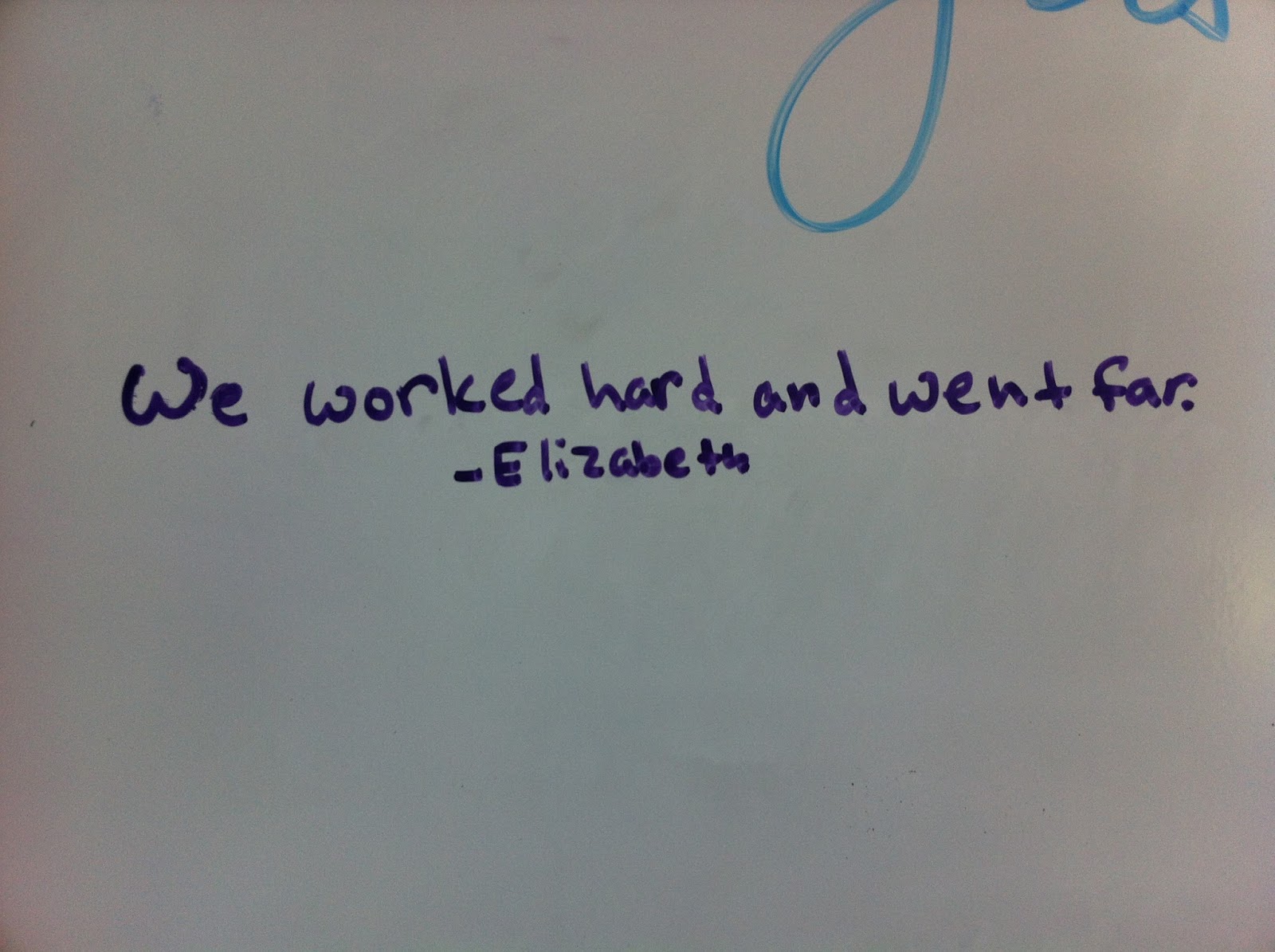
Ending the 4th Grade Year with Six Word Stories

Not a fan of ending the year with parties and movies, I wanted to do a few reflective exercises to help my students realize how far they had come in our learning journey.

I gave the following directions as I left students with my assistant teacher: Write 6 word stories, either individually, or collaboratively, that reflect what you have learned.

Of course, hands popped up and a buzz traveled through the room:

"Can we write about.. anything?" .. "Yes!"
"Can we do more than one?" .. "Yes!"
"Can we do one on our own and one with a partner?"... "Yes!"
"Can we write them on the board and sign our names?" "YES!"

By this time, my students realized that I was giving them some choice in sharing their voice. I left the room for a meeting, wondering what I would find upon return, 30 minutes later.

They say a picture is worth a thousand words, so I'll let these pictures do the talking.


How did you end your year?

Aha Moments: Have you Shared Yours?


I was searching old files on my external drive today and discovered this post, shared on Pernille Ripp's wonderful blog.  I think it's relevant to post now, especially as I return from #iste13 where I met up with so many of the people I share with on Twitter.  

Aha moments: I’ve had my share. When Pernille asked me to write and share about one of them, I initially thought, “Wait, I’m way too busy to take on something else!” And then I realized:  I need to be writing, even during this busy beginning of school time. Writing helps me clarify, categorize and sort my endless rambling of ideas and creative ramblings. I wrote back a few hours later, still a bit shaky about my “Sure, why not?”  Now, nearly a week later, deadline looming on the horizon, I am in a panic, indecisively scanning the archives of this busy mind, trying to figure out which aha moment will be most entertaining, most inspiring or helpful for other educators out there.

This ramble leads me to the biggest “aha” of all. We never stop learning and growing when we embrace opportunities that cross our paths.  Each challenge that falls before us on this incredible journey of life presents us with the opportunity to stretch, grow, and be molded into another higher version of ourselves.  We must remain open to the daily “aha” moment and somehow take the time to reflect on it, process it and act on it, so that we can grow. And on that theme I will share my top 5 aha moments that have led me to courageously move ahead on my own path of discovery.

  •              The “aha” moment that led me to be a teacher is one that always stands out in my memory.  I was sitting around that dreaded IEP meeting table, not as a teacher, but as a social worker, an advocate for a foster child on my caseload. As I listened to the condescending talk of the school psychologist, teacher, and principal to the overwrought foster parent, who was hanging on by a shred of sanity, I realized something important. Teachers, though trained to “teach” often have not been trained to understand the psychological needs that impact learning. I realized that if I had 20-30 students each year who I could spend 6 hours a day with, and if I could work with teachers, and help them understand their 20-30 kids they spend their days with, then my desire to help could be achieved in a greater way than working with the kids on my caseload, visiting them once a week. Even though I had spent a great sum of money earning a Master’s Degree in Clinical Psychology, I decided that going back to school for a teaching credential was the best way for me to help kids, my ultimate goal.


  •              Kids are eager to take on challenges and are not “lazy” as I’ve heard teachers call them. When we lower the stress and risk that comes with fear of failing, kids thrive and reach higher than we can even imagine. My post here , http://allkidscanflourish.blogspot.com/2009/03/lower-pressure-raise-bar.html describes a day when in kindergarten when I was feeling a bit helpless about working with my lowest reading group.


  • Don’t predict a kid’s future. I am not that “shy” kid I once was and I am happiest when I am creating, sharing and putting this passion for learning into practice.  I always find it amusing to think about the reaction I would have had if someone had told me, that painfully shy 16 year old girl, that my future would involve standing in front of a group of people each day, captivating their attention. If someone had told me that I would one day stand in front of 150 teachers, singing with them and sharing ideas of classroom strategies, I would have said they were crazy! We must not categorize kids as being weak or strong in a certain skill or even a personality trait. Some children have not yet been in the optimal setting to bring about the manifestation of his/her strengths. Each child has his own time frame; the best gift we can give is to provide opportunities for kids to discover, develop and express their passions.


  • Work does not (hopefully) burn you out when you do what you love! Although I am well aware that I need balance in my life, I must not heed others’ advice to “not think about teaching” on the weekend. When I am engaged in other “non-related” activities, like exercising, driving, talking with my husband, or even cleaning, I am often brainstorming how I can develop an idea into a lesson. Do I really need to tell myself that there are only certain hours and days of the week when I am allowed to be creative?


When you reflect on your years in the classroom, what were your most significant moments of self-discovery?  I'd love to hear yours! 

Monday, January 21, 2013

Using Toontastic to Build Social Emotional Skills

In spring of 2012, I was contacted by developmental and cognitive psychologist Alicia Chang from Toontastic to ask if my class would participate in a Toontastic research study. I had filled out a contact request on Toontastic's blog, wanting for my students to meet innovators and talk about their experience using the wonderful storytelling comic app Toontastic. Little did I know that my students would be part of an important study in creativity.  I asked my administration for permission and felt a bit torn by other responsibilities that kept me busy. How would I even find the time to do this?

It was quite a busy time of year, wrapping up tests and squeezing in those last bits of curriculum, but I knew that I should still carve out some time to participate. I had only wanted a one-time hour visit, but here was Toontastic's request:
  1. Students would need to use Toontastic on three separate occasions: 30-40 minute periods working with the same partners. During the third session, Andy Russell and Alicia Chang would come and observe their use as well as give a talk on innovation.
  2. Students could use any prompt that I gave them
  3. Parents would of course need to sign a consent. The consent part turned out to be easy, as all of my students' parents were in favor of their students getting excited about connecting with successful innovators building quality apps! 
  4. Students would upload their completed cartoons with numbers associated to their team and session numbers so that researchers would know during which session a cartoon was created. They were going to study how students' use of the app changed with more exposure and experience. 
I decided that my story prompt would relate to social and emotional learning, since I was always trying to squeeze in more opportunities for students to learn and practice better communication skills, build empathy and perspective taking, and resolve conflicts effectively. 

The task: Students were directed to compose Toontastic cartoons/stories about conflicts that happened on the playground or anywhere at school. They needed to follow the story arc provided in the app, (pictured below) using the stages and music to enhance their narration of the story.

They worked in pairs and trios (chosen by me) to devise their stories: choosing the scene, main characters, setup, conflict, challenge, resolution and more. Collaborating on these stories was indeed a practice of utilizing effective communication skills and taking turns being the leader and director!

The result: Students reported that they really enjoyed working together to develop these stories. They devised conflicts about excluding and including peers, arguing about fairness on the playing field, and resolving everyday issues on the playground. Of course there is no scientific way to measure how this impacted their "real" conflicts, but I can say that it gave them practice in analyzing precursors to conflict and how they build into bigger events before they resolve them.  As you can see from Toontastic's charts below, students definitely showed a higher level of engagement, a deeper exploration of complex emotion, and an increase in descriptive language over the course of the sessions.

You can read the detailed results of the study here.

Charts property of Toontastic


Here is a video of my students in action from this article:
Andy and Alicia finally came to my class to observe session 3. Andy even taught my students to prototype on paper! You can read about this fabulous experience here.

You can also view my students'  "toons' on our Toontastic channel.

Toontastic, as you can see, is an engaging tool where students can develop stories, explore interpersonal conflicts and solutions, and work with peers to collaborate creatively! 

Sunday, January 20, 2013

What's Your Sentence? An Exercise in Exploring the Self

 Throughout the school year, I am always trying to find ways to help my students discover themselves, their passions, strengths, and identify the skills that they will need to achieve their lifelong dreams. I know.. a bit lofty, but it's important to take some these initial small steps in 4th grade!

I did this activity with students last January,  and since it went well, and it’s a new year, it's a great time to re-examine goals and ideas about who we want to be.

I showed students this Dan Pink video: What's Your Sentence?

Two questions that can change your life from Daniel Pink on Vimeo.
I challenged 4th graders to think and brainstorm about who they want to be in 2012. I asked questions like:” What is something you want to be able to say about yourself?” “What is a quality or an action you want to be known for?”

I also showed them this video clip where Dan Pink invited people all over the world to share their sentences.


Students wrote the sentences you see below and followed up the next day by writing blog posts about why they chose this sentence and what they will need to do to make it happen!  

You can read the students' blog posts on their Kidblogs by visiting here. 
One reason I had them blog about these sentences was to share their ideas and converse with a variety of people about these goals. Feel free to add a comment or ask a question. They love comments on their blog posts!
If you click the picture, you can read the sentences more easily.

Adding the blogging part to this activity helps students refine their statements by talking about how they will achieve their goals, connecting to others who might share similar passions, and creating a positive vision of their future. Providing an authentic, global audience enriches this experience in remarkable ways. One student, upon realizing that someone from New Zealand had commented on her blog, yelled out in class, " Someone from New Zealand read my post!" Powerful stuff for a 4th grader!

How do you help students discover and share their passions and goals?

Snowflakes for Sandy Hook: Responding to Sandy Hook (part 2)


The day after we had our class discussion about the tragedy in Sandy Hook, I learned of an opportunity for students to "do something," to respond in a way that would help them somehow feel like they could help the famlies of Newtown CT. We took an hour out of our schedule to show the families of Newtown, CT that our thoughts and prayers were with them.
We created beautiful snowflakes to decorate the new space that Sandy Hook students will return to after winter break. The PTA requested these here as a way for students around the world to show their support.
As our students worked on snowflakes, our class reporters video interviewed them about how they felt while performing this small, yet powerful act of kindness. Several reasons for capturing the videos popped into my mind: I wanted to be able to hear the responses and know more about how my students were feeling, and I know that my students love to speak on video and are more open than in a large group discussion.  Finally, I also wanted to be able to share their thoughts and feelings with their parents and our school community. I posted the private Youtube links on my class blog. Due to confidentiality, I can't share the videos, but I have recorded some of the interview comments below.
Here are some of their responses taken from these interviews about how it felt to create these beautiful snowflakes and hopefully make someone smile.
Q: Why are you doing this?
A: "It will brighten them up to see snowflakes. Maybe they will be able to think of something else than their sadness and focus on the beautiful snowflakes."
We want to make a difference, instead of just sending them letters, like to say, Happy Christmas, we are actually "making things" so we can make them happy.
We are doing this to support people.
Q: So, why do you care?
I care because losing a family member is sad and makes you not focused, so maybe something happy can help them focus on something else.
It's important because people are really sad. It's important to do things for other people.
I know what it feels what is like to have lost a loved one and I think it's important to do something nice. It makes me feel happy and it's nice
Q: How does this make  you feel, to do something to help?
It makes me feel good because I can do something and make a difference instead of just sitting there and not being able to help.
I know what it feels what is like to have lost a loved one and I think it's important to do something nice. It makes me feel happy inside.  
In times of tragedy, kids need to feel empowered to "do something" and to be part of a solution. My students enjoyed making their snowflakes for Sandy Hook, and openly shared their feelings about making the snowflakes.  I was able to understand more about how they were  processing this horrendous event, by watching the video interviews. By sharing the interviews with their families, I was able to model an open dialogue on difficult topics. 
How do you help kids "respond" to tragedies like these? 


Creating Space for Difficult Conversations: Responding to Sandy Hook (part 1)


It was the Monday after the tragic shooting at Sandy Hook Elementary School. We, (the teachers at my school), had been told to not talk about the tragedy unless a student brought up the topic. I knew that if I created the space and opportunity, the discussion would happen.
We began the day with our class meeting, and talked about the range of feelings many of us experience during a typical day. We also talked about how conflicting emotions can occur during times like the holiday season.  Many of us miss loved ones who are not here, yet feel excited about Christmas.
As we have done several times before, we chose emotion cards
This is only a small sample of all of this wonderful set of cards! 


to identify how we were feeling this morning. Replies like, "I'm feeling happy about Christmas with my family," were punctuated with contrasting feelings: " I don't know.. just a little tired and out of it." After each student shared, I thanked them for their honest reflection as I always do. Of course, any student could pass if they did not feel like expressing or identifying their feelings.
About a third of the way around the circle, a student shared feelings of happiness about Christmas, yet sadness about what happened in Connecticut on Friday. The student did not elaborate further and paused.  A couple of students were puzzled. "Wait, what happened on Friday?"
I decided that we would hear all of our other friends' feelings before moving back to the topic, realizing that a couple of students were unaware of the tragedy. I wanted to be sure that the discussion focused on the many measures we take to ensure students' safety and security at our school.
After allowing the rest of the students to choose their cards and share their feelings, I returned to the topic of Friday's tragedy.
We discussed the incident as a shooting at a school, and encouraged students to focus on any feelings they might want to share. I asked them to not go into graphic detail, (though 4th graders often want to talk about weapons), out of respect for others. I also emphasized the importance of not discussing this topic around younger students and that many parents have different feelings about what they want their children to know.
I am so proud of all the children in my class who so sweetly shared their kind thoughts and words about others and their suffering. I reminded them that I am here for them, all day, anytime, by email or in person to listen if they have a concern.
We also talked about the best way that we can "do something" if we want to help in some way. We can, first and foremost, be kind to ourselves and each other, and reach out to our parents and trusted adults if we feel scared or worried. I told the class that I would be on the lookout for any way we could help, but that it's best to find out what people really want or need before just sending cards or letters. 
It was one of my most difficult conversations, but definitely one worth having. I knew that I would need to find some "action," some way of helping others so that my students could feel a sense of empowerment and share their desire to contribute.  
How have you handled the discussion about Sandy Hook and other tragic events?
Sunday, December 9, 2012

The One and Only Katherine Applegate..

 It all started this past summer, as I was tweeting about recent books I had read: The One and Only Ivan, by Katherine Applegate and One for the Murphys, by Lynda Mullaly Hunt The conversation continued as you can see below, and I was thrilled to schedule Katherine Applegate for a visit.


Fast forward to Friday, December 7th, a fantastic day for 3rd, 4th, and 5th graders at my school,  as they got to meet Katherine Applegate, author of the wonderful book we read for the Global Read Aloud, The One and Only Ivan.
We were so excited to get our autographs!

I think that I was the biggest kid of all! I love authors of great books like Ivan.

Katherine did a wonderful job telling the story of the real Ivan.

I loved the way she invited students to be writers and think like Ivan.

One of my favorite slides: showing the number of crumpled drafts it takes to write something worth sharing!

So many questions to answer!

Hands were flying up everywhere with great questions about what was fact vs. fiction in Ivan.


I am so thrilled that our students had this opportunity to meet an author whose book they adored! Katherine validated the notion that writing is very challenging work and encouraged our young writers to keep working hard on the craft of writing. Thank you, Katherine, for taking your precious time and spending a Friday afternoon with  us!